


Day six is about doing something most wedding planning content doesn’t do well: getting specific about where to actually save money on your wedding without making it feel like a compromise.
Because there’s a big difference between a wedding budget cut and a sacrifice — and the best wedding budget moves are the ones that trim cost without trimming joy. Today we’re talking about payment schedules, tracking habits, invisible cost cuts, the splurge vs. save framework, and the simplest possible hack for freeing up thousands of dollars without changing a single thing about your vision.
It starts with understanding where your money has the most impact — and where it quietly disappears.
The Difference Between Cutting and Compromising
Not All Reductions Are Created Equal
A cut is removing something from your wedding budget that nobody will notice or miss. A compromise is removing something that matters — to you, to your guests, or to the experience you’re building.
The goal of smart wedding budget management is to find every possible cut before you ever make a single compromise. Most couples skip this step. They start reducing the things they love before they’ve even examined the things they could quietly eliminate.
Here’s the framework. Before you touch anything you care about, ask three questions about every line item in your wedding budget:
- Will my guests notice if this isn’t here?
- Will I notice in the photos ten years from now?
- Does this add to the experience, or does it just add to the cost?
If the answer to all three is no, that’s a cut. If the answer to even one is yes, that’s a potential compromise — and it deserves more thought before you remove it.
The best place to find cuts is in the categories where social expectation drives spending more than personal joy does. Favors, inner envelopes, elaborate cocktail hour displays — these often exist because couples feel like they’re supposed to have them. Not because they truly want them.
Understanding Your Vendor Payment Schedule (And Planning for It)
Your Wedding Budget Is Not a One-Time Payment
Most couples think about their wedding budget as a total number. But in practice, your wedding budget is a series of payments spread across 12–18 months. Understanding that timeline — and planning for it — is one of the most important things you can do for your financial sanity.
Here’s how vendor payments typically work:
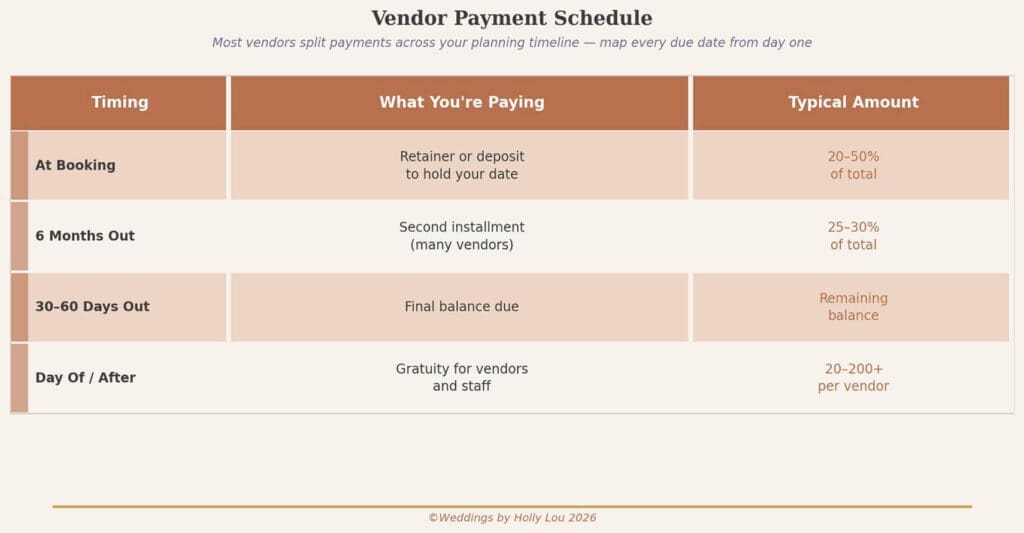
The danger zone is months eight through ten of planning. That’s when final balances start coming due across multiple vendors simultaneously. Couples who haven’t planned for this hit a cash flow crisis right before their wedding day.
How to Avoid the Final-Month Crunch
- Map every vendor payment and due date into a single calendar from day one.
- Set aside final balance amounts in a separate savings account as you go.
- Negotiate payment schedules when you book. Many vendors have flexibility.
- Never let a balance due date surprise you. Know the number and the date months in advance.
- Build a 5–10% buffer into your total wedding budget for unexpected costs.
Create a simple spreadsheet with three columns: vendor name, amount due, and due date. Sort it by date. Review it monthly. This one habit eliminates nearly all payment-related wedding budget stress.
The 5-Minute Habit That Protects Your Entire Wedding Budget
Track It or Lose It
Budget tracking is not glamorous. It is also not optional if you want to actually stay within your wedding budget. The couples who go over budget almost always share one thing in common: they stopped tracking regularly, or they never started.
The habit is simple. Once a week, for five minutes, do this:
- Open your wedding budget tracker.
- Enter any expenses from the past seven days.
- Compare your running total to your allocated amounts per category.
- Flag any category that is within 10% of its ceiling.
- Decide if anything needs to be adjusted before next week.
That’s it. Five minutes. Once a week. Done consistently, this habit means you always know where you stand. You catch overages in real time instead of discovering them at the end. You make small adjustments continuously instead of facing a major reckoning in month eleven.
Best Tools for Wedding Budget Tracking
- Dedicated wedding apps: The Knot, Zola, and Joy all have built-in budget trackers.
- Spreadsheets: A simple Google Sheet with categories, budgeted amounts, and actuals is completely sufficient.
- Notes app: Not ideal but better than nothing. At minimum, log every expense the day you make it.
The best budget tracker is the one you will actually use. Don’t build a complicated system you’ll abandon in month three. Simple and consistent beats elaborate and ignored every time.
15 Cost Cuts Your Guests Will Never Notice
Real Savings. Zero Sacrifice.
These are not theoretical savings. These are real wedding budget cuts that experienced planners and photographers see couples make successfully at every price point. Not a single one of them will show up in your photos, affect your guest experience, or change how your wedding feels.
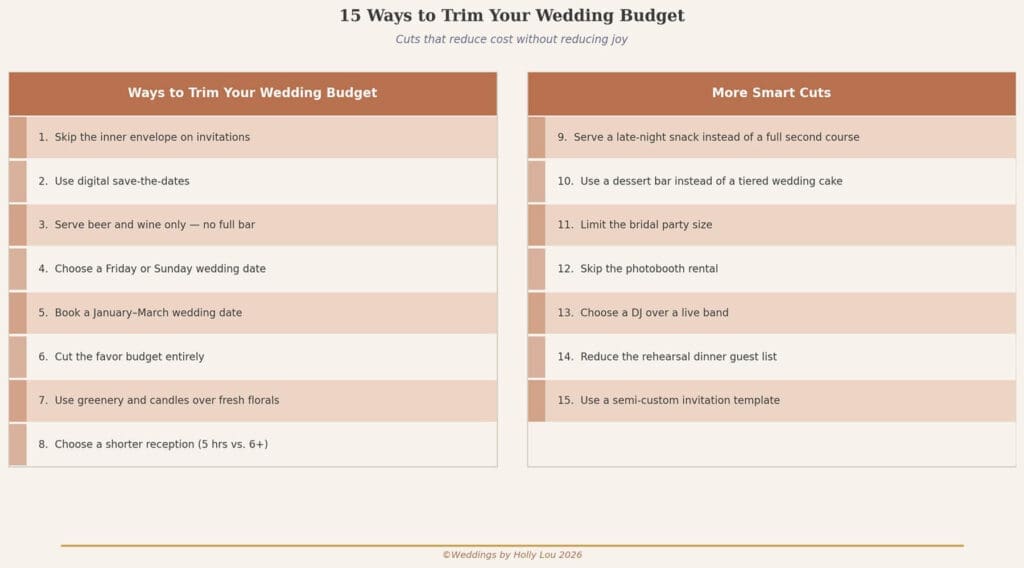
The savings across these 15 cuts can range from $500 to over $8,000 depending on how many you apply and your guest count. Start with the ones that feel easiest. Work toward the ones that require a conversation with your partner or family.
The Splurge vs. Save Framework: Where Your Dollars Have the Most Impact
Spend Big Where It Shows. Save Hard Where It Doesn’t.
The splurge vs. save framework is the single most useful mental model for wedding budget decision-making. It asks one question before every purchase: does spending more here create a meaningfully better experience, or does it just cost more?
Here’s how the framework plays out across the major wedding categories:
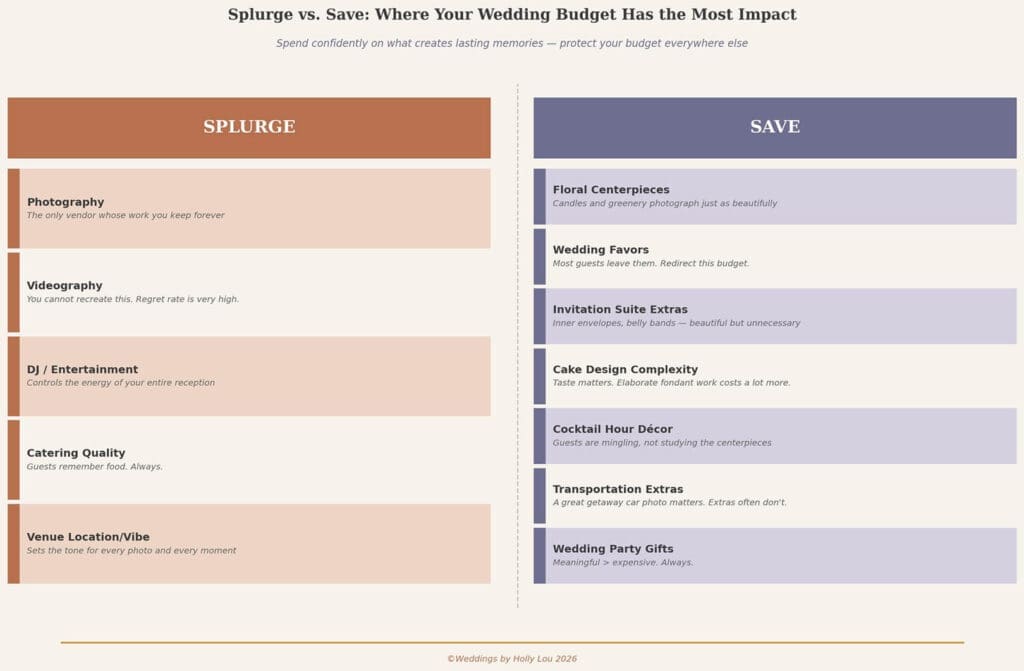
When you apply this framework consistently, your wedding budget stops feeling like a series of random trade-offs. It becomes a set of intentional decisions where you know exactly why you’re spending what you’re spending — and why you’re not spending what you’re not.
The splurge vs. save framework is not about spending less overall. It’s about spending confidently — putting real dollars toward the things that create lasting memories and protecting your wedding budget everywhere else.
Off-Peak Dating: How Changing One Variable Saves Thousands
The Single Biggest Wedding Budget Lever Nobody Talks About Enough
If you have flexibility in your wedding date, this section could save you more money than every other tip in this guide combined. Wedding vendors price based on demand. Demand is highest on Saturday evenings in peak season. Demand drops significantly everywhere else.
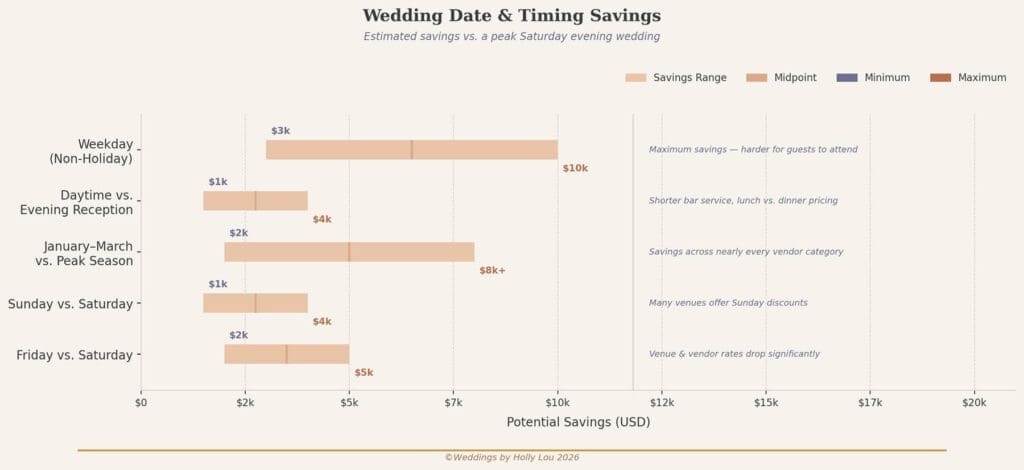
A January Friday wedding can cost 25–40% less than a June Saturday wedding at the same venue with the same vendors. That is not a small difference. On a $35,000 wedding budget, that’s $8,750–$14,000 in real savings — without changing a single thing about the aesthetic, the vendor quality, or the guest experience.
What Off-Peak Actually Means in Practice
Off-peak is not a synonym for cheap or low-quality. It simply means you’re getting married when fewer people are competing for the same dates. Your photographer is still your photographer. Your venue is still your venue. The flowers look the same in January as they do in June.
The trade-off is real: some guests may have a harder time attending a Friday evening or a January wedding. Have that conversation with your partner before you lock in a date. If the savings matter more than the Saturday convenience, off-peak is worth serious consideration.
Ask every venue you tour about their off-peak pricing before you discuss Saturday availability. The gap between their peak and off-peak rates will tell you exactly how much flexibility is worth to you.
How to Renegotiate If You’ve Already Gone Over Budget
It’s Not Too Late. But It Does Require Honesty.
Going over your wedding budget is not a character flaw. It is a very common result of planning something this complex for the first time. What matters now is how you respond.
If you’re looking at your wedding budget tracker and the number is bigger than your total, here’s what to do:
Step One: Get the Real Number
Add up everything. Every signed contract, every pending payment, every category you haven’t booked yet but know you need. You cannot fix a problem you haven’t fully quantified. The real number, even if it’s uncomfortable, is your starting point.
Step Two: Identify What’s Signed and What Isn’t
Signed contracts with deposits are largely fixed. Unsigned or unbooked categories still have flexibility. Focus your energy on the categories where you still have decisions to make.
Step Three: Go Back to Vendors Before Final Balances Are Due
This surprises most couples: vendors will sometimes negotiate — especially if you ask before the final balance is due rather than after. Here’s how to approach it:
- Be honest. Explain that your overall budget is tighter than expected.
- Ask if there’s a version of their service at a lower price point.
- Ask if any add-ons can be removed to reduce the total.
- Never ask a vendor to reduce their core rate. Ask about scope reductions instead.
- Be gracious. A vendor who works with you deserves extra care and an excellent review.
Step Four: Find the Cuts Before You Cancel Anything You Love
Before you sacrifice something meaningful, go back through the 15 cost cuts listed earlier in this guide. Work through the splurge vs. save framework. Look at every unbooked category for a lower-cost alternative. Exhaust the cut list before you touch the compromise list.
If the overage is significant and the math truly doesn’t work, have the honest conversation with your families before you put expenses on credit. A temporary budget increase from family is almost always less damaging than starting your marriage in debt.
Building the Budget That Feels Like Your Wedding
The Goal Has Never Been a Small Number
The goal of your wedding budget is not to spend as little as possible. The goal is to spend intentionally on the things that matter and protect the rest. A $20,000 wedding can feel completely right for one couple. A $60,000 wedding can feel completely right for another. The budget that’s right for you is the one that reflects your priorities — not someone else’s expectations.
Here’s what a budget that feels like your wedding actually looks like:
- Every line item has a number attached to it — no vague “we’ll figure it out” categories.
- Your top three priorities have the largest allocations.
- You’ve applied the splurge vs. save framework to every major category.
- Your payment schedule is mapped out with due dates and amounts.
- You have a 5–10% buffer built in for the unexpected.
- You’re tracking it weekly.
When your wedding budget has all six of those things, it stops being a source of anxiety and starts being a tool. A tool that gives you permission to say yes to the things you love and no to the things that don’t matter — without guilt, without guesswork, and without that creeping feeling that you’ve lost control of the plan.
A wedding that costs what you said it would cost is a win. A wedding where you felt confident in every decision is a bigger win. Both are completely achievable. Start with the budget. Build everything else from there.
The Bottom Line on Saving Money on Your Wedding
Smart wedding budget management is not about finding the cheapest version of everything. It’s about knowing the difference between a cut and a compromise — and having the clarity to make that distinction before money gets spent.
Track weekly. Map your payment schedule. Apply the splurge vs. save framework. Consider the date. Revisit your vendors before final balances are due. And build a budget that reflects who you actually are as a couple — not who you think you’re supposed to be on this day.
You’ve got this. And the wedding on the other side of this planning process? It’s going to be exactly right.




+ show Comments
- Hide Comments
add a comment